Tuesday, June 16, 2015

To Torres del Paine

From Puerto Natales to Torres del Paine  January 18, 2015

We took an indirect route from Puerto Natales, Chile, to Torres del Paine National Park.  First, we did a catamaran cruise down the Fjord to National Park Bernardo O'Higgins.  This is a standard tourist day trip/excursion from Puerto Natales.   From there, we went up the Rio Serrano in zodiacs to get to Torres del Paine.  A great alternative to a two-way bus ride to the park.

The fjord was full of lovely waterfalls.  This is one of many we saw.  The fjord is called el Seno de Ultima Esperanza (the sound of Last Hope, maybe because it's a dead end and doesn't lead to the southern passage?) but was incredibly lovely.  It was the home of another canoe-living group of folks, the Kawasekar, which had a similar lifestyle to the canoerers in Tierra del Fuego, living naked just with sea lion fat, living in the boats with only temporary settlements on land, very strong upper bodies from rowing. 

View of the Andes from the fjord.

View of Torres del Paine massif from the fjord.  We learned to tell which were the horns and which were the towers and now I'm writing this up I can't remember!  But we got to see their irregular peaks from many angles over the next few days.

The Balmaceda glacier in the Bernardo O'Higgins National Park, at the end of the fjord.  It's not connected to the ice sheet, and is retreating.   Our visit to Patagonia was peppered with evidence of global warming and glacial melt.  At the base is a newly formed glacial lake, and on the walk there, we kept seeing poles that marked dates when the glacier had reached up to 500 M or more out from its current limit.  The newly formed lake of glacial melt is peppered with icebergs.  It's shrinking rapidly.  There were several Andean condors (ie buzzards, with a wingspan of over 2 meters) riding the thermals over the glacier, and one is in the upper L side of the photo, very small. 

After the walk to the glaciar, we borded a zodiac for the ride up the Serrano river to the campsite.  It was a nice day, but we suited up because of the wind.  Silas was very happy at the start of the ride, and soon fell asleep.  The rest of us checked out the scenery and a solitary sea lion that had braved coming up river to hunt for salmon.


This is looking back over the Serrano towards Bernardo O'Higgens park.  It was just lovely.  The river is pretty grey, full of glacial milk, and as we got closer to the park and the glaciers, you could see changes in color as a glacial or rain-fed tributary fed in.

After the ride, we had parilla (grill) before going on to our campsite.  The other guests had grilled meat with salad and bread, which we came to learn is the standard BBQ, sometimes with sausages, often with lamb.  We had omelets.  We often got disbelief or chagrin from folks when we said we were vegetarian, along the lines of, but in Argentina (and Chile) they grill so much meat, too bad you'll miss it and anyway what can you eat?  But the truth is, we rarely had problems.   Self catering helped, and I got very good at quickly perusing posted menus to see which restaurants would be better for us, but we had more issues overall with picky kids than finding vegetarian food.  Other new food words learned early in the trip:  palta (regional for avocado) and manjar (the Chilean version of dulce de leche).

Next up:  Torres del Paine.

Monday, June 15, 2015

Around Cape Horn

January 15-17, 2015 we took a 3-day cruise from Ushuaia, Argentina to Cape Horn and ending in Punta Arenas, Chile, travelling through the Beagle Chanel and Straight of Magellan.  It was incredible.  We like these small, educational cruises with lots of excursions.

We sailed out from Ushuaia and the next morning took off in zodiacs from our boat to land at Cape Horn, which is an island on the end of an archipelago south from Tierra del Fuego, which is itself a very large island separated from the American continent by the Straight of Magellan.  Silas loved the zodiac rides, which we took every day on excursions.  The next photo is of all of us on the Cape Horn island.  It was cool and very very windy.  Mike carried Silas a good bit, and kept getting pushed around by the wind.  There was a statue of an albatross on the highest hill of the island that had been built to withstand 200K winds, and had broken.  There is also a lighthouse, and the keeper and his family are part of the Chilean Navy.    All the islands in the background are part of Chile. 

The island itself was quite green, covered with grasses and plants but no trees.  It was a lovely high-summer day.

The next day, we got out to visit a glacier in Agostini national park, on an island south of the Beagle Chanel, that has a glacier.  This park and the Darwin Range, & islands are the tail end of the Andes, and the park is named for an Italian priest who was also a mountaineer and explored a lot of the southern Patagonian Ice Sheet.  The Marinelli glaciar,  the second one we'd seen after Glaciar Martial in Ushuaia, isn't connected to the ice sheet.  It's just hanging out all by it's lonesome, and like almost all the glaciers we saw, it's retreating rapidly. In this same park, we did a short hike to a lookout, found & tried some Pan de Indio, an edible fungus that only grows on Nothofagus trees, and saw a ton of beaver damage, which is prevalent around Tierra del Fuego.

On the way back to the zodiac launch point, we had a view of an awesome double rainbow and our cruise boat.  The kids were quite happy about the return trip, as the crew had hot chocolate waiting for us back at the boat.   We'd seen dolphins in the bay playing around with the zodiacs while we were waiting to board, but didn't see any more on the way back.

The last day on the boat, on the way in to Punta Arenas, the southernmost big town in Chile, we  stopped at Magdalena Island National Par.  The park has hundreds of thousands of pairs of Magellanic Penguins, as well as many gulls and skuas.  The babies here, like those in the Beagle Chanel, were starting to molt into their swimming feathers. We enjoyed the walk on the island, but were perhaps less overwhelmed because we'd already been up close and personal with penguins one time in Argentina.   At lunch we got dropped off in Punta Arenas, where we had 4 hours before needing to catch a 4 hour bus to Puerto Natales & camping in Torres del Paine.  

Punta Arenas was an interesting town, and deserved more time than we spent there. There was a huge cementary with large topiaries we spied on the way out of town, and several lovely mansions in town, one with a greenhouse with grapes,  that had been build by Patagonian cattle/sheep barrons. These families  (Braun-Menendez) were related to the families in Argentenian Patagonia and had & still have vast empires, including owning La Anonima, the largest Patagonian grocery chain that we used throughout our travels.  The also owned Estancias in Argentina where socialist workers were killed in the early 20th century for asking for better labor conditions.  The pervasiveness and historical power of these families were everywhere, and we ran into the same names over and over as being weathy owners, starting in Punta Arenas.  They are seen as pioneers, founding fathers, wealthy aristicrats, and evil capitalists who called in the army to kill their workers.  Their story is one of hard work leading to great wealth and the myth of immigration to make a better life.  It very much parallels similar myths of rags to riches pioneering possibilities of the westward expansion in the US.

Mike had been out of internet contact and would be for another week, so after a quick lunch in a pizza joint (not exciting) he hit an internet cafe while the kids and I picked up our luggage and went to the bus station, and off to the next leg of the trip.


Wednesday, June 10, 2015

Preparing for reverse culture shock

We are starting to prepare for our return to Seattle in August.  In fact, I'm currently on a 1-week trip to the US, for the first time in over 10 months.

These are things we are looking forward to in the US:

  • appliances such as clothes dryer, dishwasher, kitchen gadgets; reliable hot water and Internet
  • bank account (we are on a tourist visa, so we can't can't get a debit or credit card, a mobile phone contract, etc.  Everything is on a cash-as-you-go basis)
  • bicycling
  • kids staying at school for lunch

These are things we will miss on our return to the US:

  • high density = close to everything.  There is always something going on at the 1000-seat event stage that is less than a block from our house, and that's just one example.
  • subway and high-frequency bus service
  • great fruit.  We have fallen in love with pomegranates, but that's just one example.
  • warm, sunny weather.  Now that it's winter in Buenos Aires (the equivalent of December in the northern hemisphere), it is cold enough that the kids don't always wear short sleeves, but it is still sunny nearly every day.


Sunday, May 31, 2015

Ushuaia, Argentina

I'm going to back-post from our travels around Tierra del Fuego and Patagonia in January-February 2015.  This first posting is from Ushuaia.  We flew overnight on a very long flight from Madrid to Buenos Aires.  We dropped off luggage with one of Mike's colleagues and spent the night in a hotel near Jorge Newberry, the national airport.  An interesting note, in our less than 12 hours in BsAs, we learned about Remis (pre-pay taxes), Mike went to a cueva to change money, and while eating dinner in a diner, we learned our first Argentinaism - for strawberry icecream, instead of being "fresa" in Argentina, it's "frutilla."  Then we were off to Ushuaia, the southernmost town in the world.
This is a lovely photo of ground-dwelling Tierra del Fuego Orchids.  There are several kinds that grow there, but we only saw this one.   It also shows rotting wood, very unlike our Pacific NW forests with lush nurse logs.  Dead wood can hang around for years, rotting very very slowly.  The cap of dirt is also very thin, because of the slow rate of decomposition in the cold climate.  This was on a 9k hike we did in the Tierra del Fuego National Park, about 10k outside of Ushuaia.  We got taken there & picked up by taxi, on a day that multiple cruise boats were coming into port.  We figured it was a good day to be in the woods, and it was.  Another ?? we first saw in TdF was this:  pan de indio.  We had no idea what it was, but we saw it everywhere hanging on trees - which it turns out were all Notofagus or Southern Beech.  Pan de Indio is an edible fungus and very protein-rich.  After we figured out what it was, we ate some (about a week after this).  It's spongey and crunchy and pretty flavor-less.  It was a staple in the diet of the canoe-dwelling Native Americans before the Europeans came. 

 The path we took through the park paralleled the Beagle Channel.  This was about half-way in, at a lovely stopping spot, where a very nice Argentinan couple took our photo and shared their Mate with us.  Mate is a tea made from Hierbamate which is drunk everywhere in Argentina in special cups with straws that strain the tea leaves.  It's common to see folks carrying around thermoses full of hot water and mate cups, and they share.  In our 6 weeks of travel, someone must have offered us to try their mate at least once a week.  Mate with sugar, bitter mate, cold water mate, you name it.  Mike, Maeve and I all tried it.  It was bitter.
You can see the Beagle Channel and Chile.  The other side of the chanel is Chile, and at that latitude, the snow line was at 600 M.  These mountains are the tail end of the Andes as they dip into the sea.  You can see that we're wearing jackets and caps, even though it's July 11, high summer.

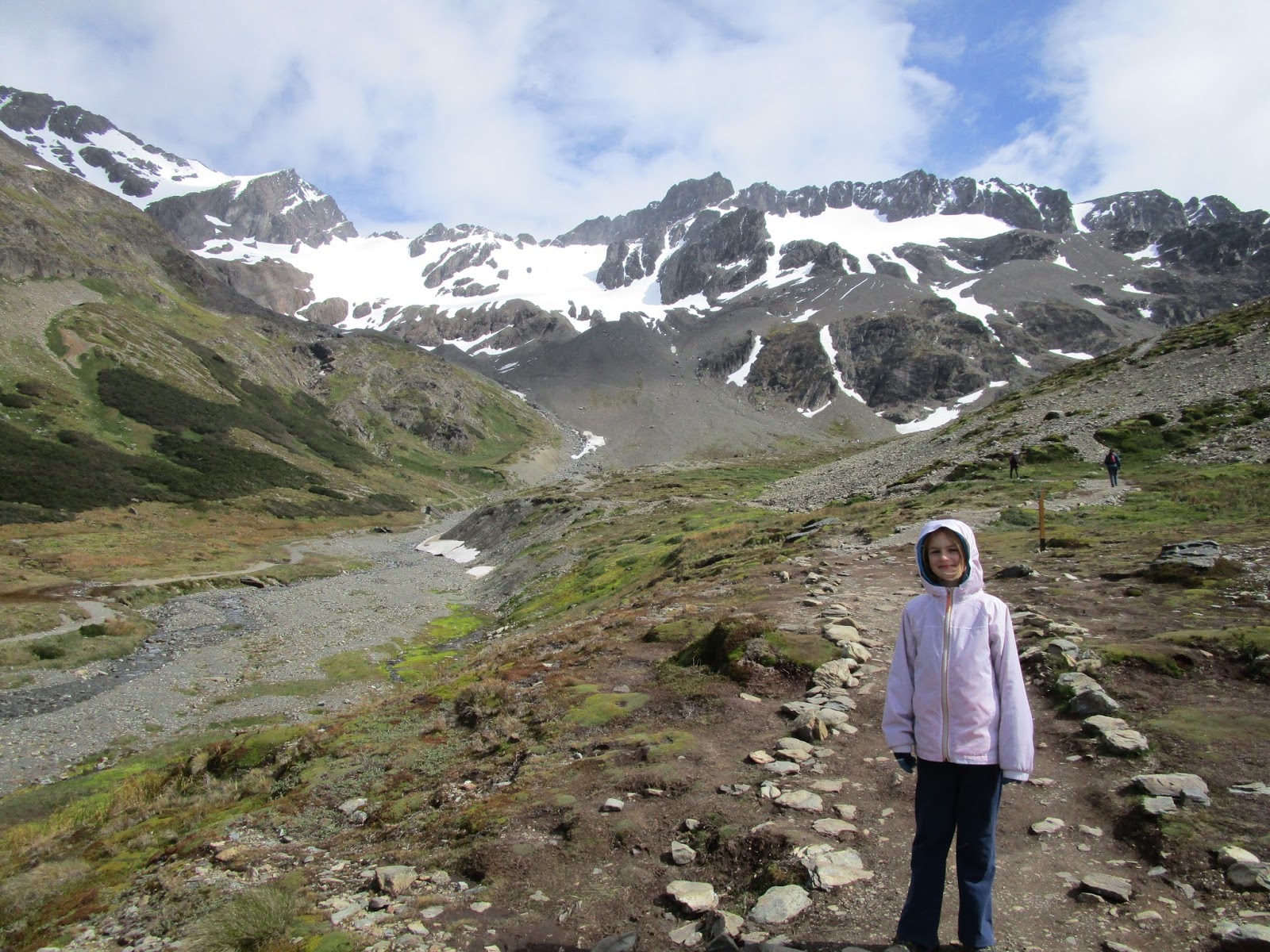
Another day we did a hike up a ski slope towards Glaciar Martial, which you can see behind Maeve.  It's a great hike to the glaciar, but we didn't go all the way up, stopping to play on a snow field well below the glaciar, where we also got snowed on a little bit. Another lovely summer day. We also saw skiiers making their way up a snow field to later ski down.   This glacier provides Ushuaia with drinking water.  

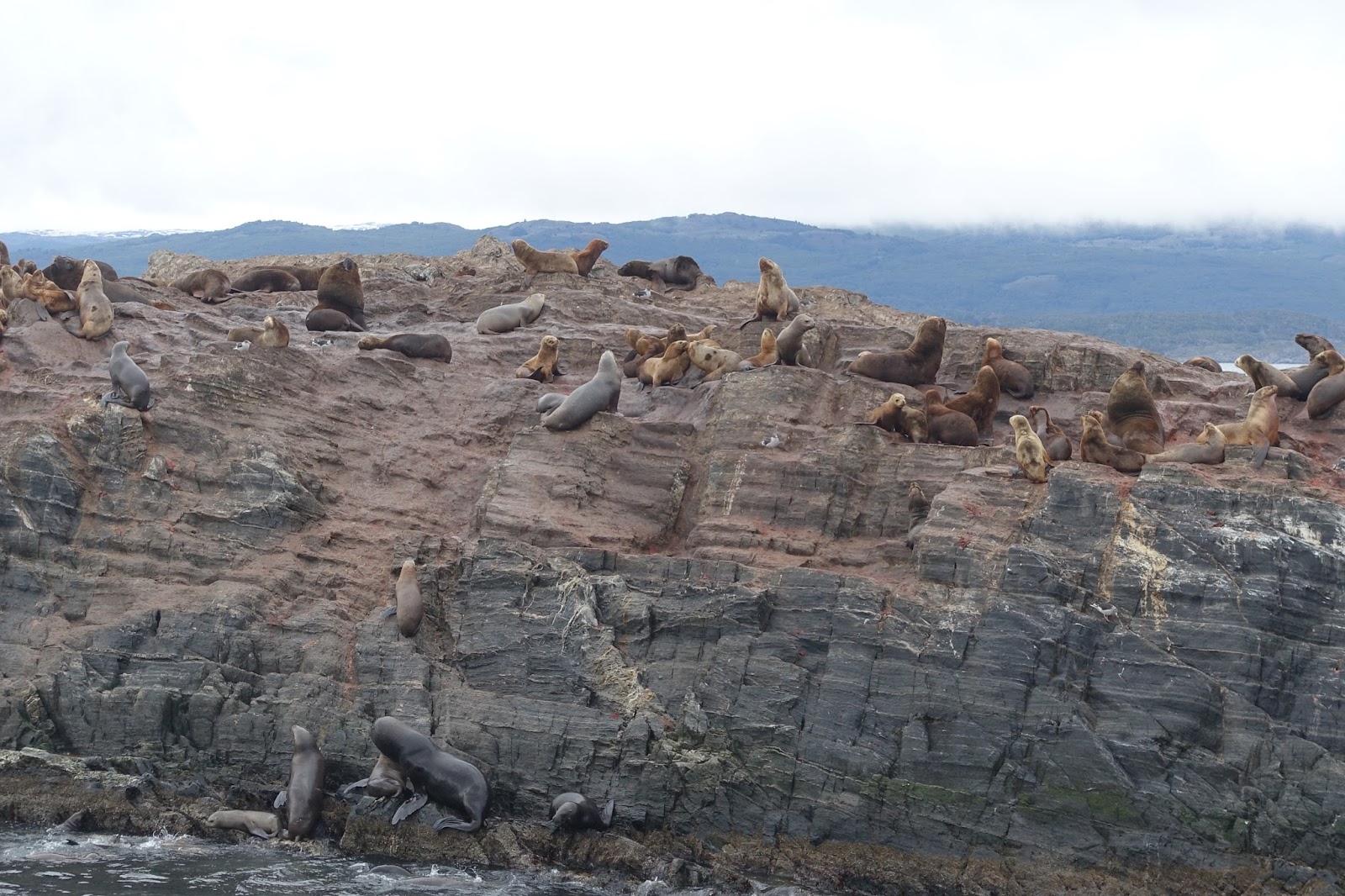
One day, we took a boat trip to Estancia Haberton.  This is a view of Ushuaia, with the mountains and glaciars in the background.  It had snowed at higher elevations (over 600M) overnight and you can see the snow line.  Estancias are plantations, and Haberton was one of the first ones in the Ushuaia area, founded by an English family who had a long history of studying the Canoerers who lived there. The Estancia is no longer active in sheep farming or other agricultural activity, and is run as a museum.  The trip out was through the Beagle Chanel to the East, where we saw islands with rock cormerants and this colony of sea lions.


Part of Haberton is an island that's now a private nature preserve with lots of penguins.  In our trip, we saw the island from our big catamaran, then took zodiacs from Haberton to beach on the island and walk around.  This was AMAZING!  There were over 10,000 Magellanic penguins in the colony.  They were everywhere on the beach, in their burrows, and their babies were molting into adult swim plumage.  There were also 2 Emperor penguins on the island - our guide wasn't sure, because it's only the second year Emperors have been there and it's far north for their range, but it's possible they're checking it out to build a larger colony in the future.  They were huge comparted to the little Magellanic penguins.  There was also a small colony (about 100) Gentu penguins on the island.
On the bus ride back to Ushuaia, we saw some special Patagonian trees, nicely shaped by the wind, as well as lots of beaver damage.  Someone had the great idea to release Canadian beavers in Tierra del Fuego as a commerial venture.  It didn't work well, because although it's cold there, it's not as cold as Canada in winter, so the beavers' pelts weren't lush.  There were not natural predadors, and now they're a menace.  We saw beaver damage in both Chilean and Argentinian Tierra del Fuego, and there are fears they're moving into the mainland.


From Ushaia, we took a boat around Cape Horn to Chile.  In the port, we saw this wonderful mural, which is a comment on the Falkland Islands War.   Note:  Mike thinks this sign is a comment on Francis Drake, when he went pirating along the Beagle Channel.  But, there were various other signs about the Falklands.  The sign says:  "The mooring of English pirate boats is prohibited." Argentinian maps all include both part of Antartica, which Argentina claims and the Islas Malvinas, or Falkland Islands. 


Thursday, May 07, 2015

Iguazu Falls, April 1-6, 2015

I'm catching up on blogging.  I now have consistent Internet and a computer that doesn't crash, so I'm going to post going backwards for a bit, starting with our Iguazu trip a month ago and then posting from our travels in Tierra del Fuego and Patagonia in January and February.

Over Easter Break we went to Iguazu Falls with our friends from Seattle, Mark and Vanessa.  It's on the must-see list for Argentina and Brazil, and was totally amazing.
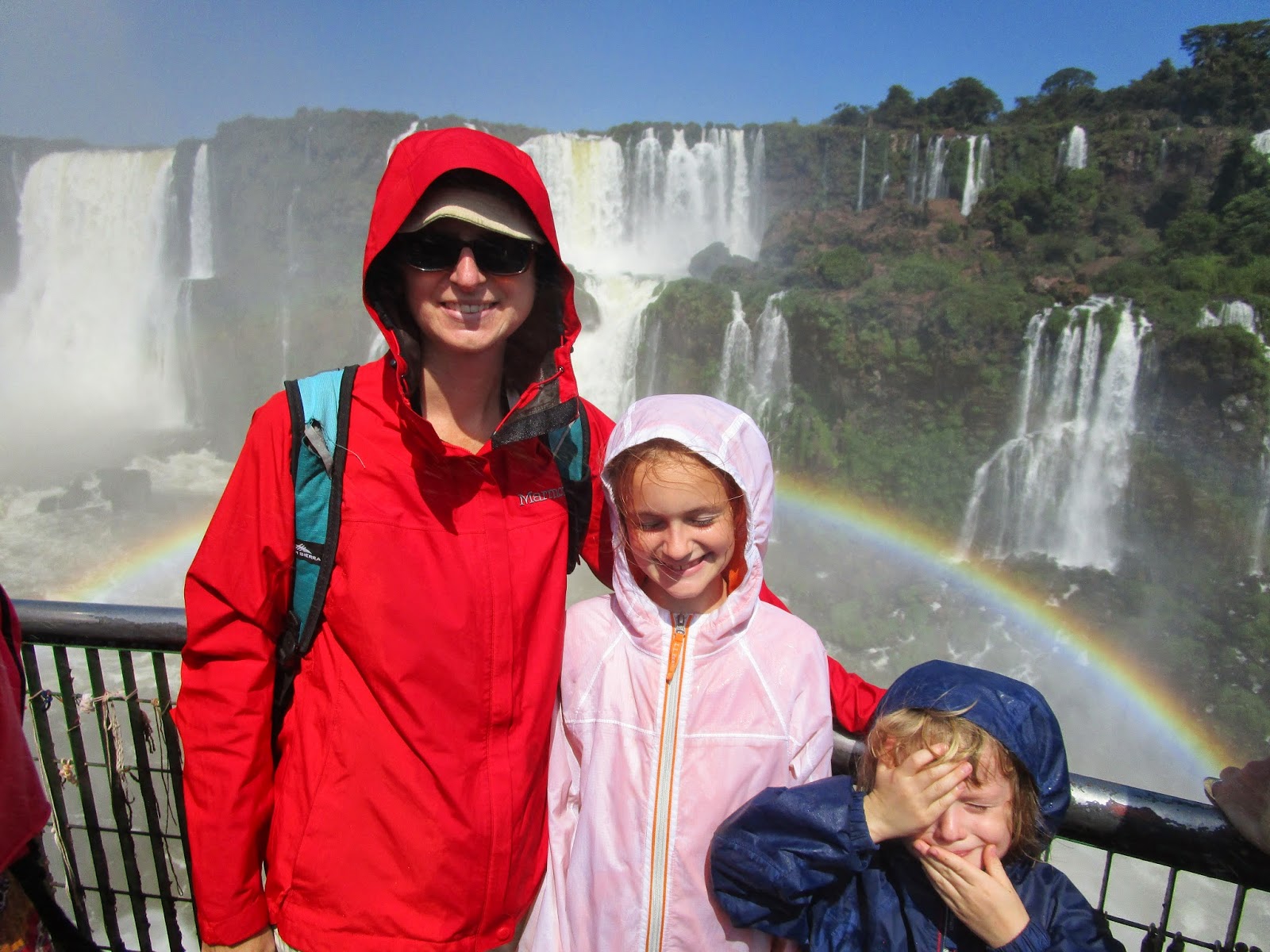
Here we all are at the Garganta del Diablo (Devil's Throat) on the Argentinean side.  This is the biggest fall of the many on the Rio Iguazu.  The spray was amazing.  There were tons of rainbows, and swallows diving behind the falls to their nests.   This is where we went first, and it was mighty impressive.  We were there on a holiday weekend, and the park was packed: the walkways right near the viewpoints were pretty busy, and the Brazil side was a crush to get to the falls walkway.  Other than than, we didn't find it too crowded.  It helped that we visited the parks for 3 days (2 Argentina, 1 Brazil).

Every day, we saw tons of these cute little critters, called Coatis.   This one was next to the rail road track, part of a group we saw while waiting at the train station for Garganta del Diablo.  They've got a long snout, racoon-like tail, and are adorable.  I took tons of photos the first day.  Later, we were trying to eat a snack, and the coatis came running.  Neither the coatis nor we got a snack there.  At a snack bar, there was a park employee with a net running around netting and scaring coatis to keep them from the tourists.  Argentina had coati-proof trash cans.  Brazil didn't, and the coatis climbed up and in the trash.  They were a total menace.  There's a nice short story by Horacio Quiroga about coatis that's also worth reading (English, Spanish). 

This is in front of Garganta del Diablo, looking downstream.  Lots of spray.

In addition to coatis, we saw other wildlife.  There are big cats in the park, but they stay far from the hordes of tourists.  We saw some birds, and a band of capuchin monkeys the last day which was amazing, but what there was lots of was butterflies.  The kids became experts at having them land on them, and at one point both Maeve and Silas had 3 or 4 on their arms.  Many were white, black and orange, and there is a very large blue one, but it was shy.  There are also swarms of yellow butterflies that apparently live only 1 day in butterfly form, mate, lay eggs, and they're done.   

Another view of some of the falls, Argentina side.  The rainbows were amazing.  Really, the falls just go on and on along 3km of river, and there are several walkways on the Argentina side to see parts of them.


Silas didn't much like getting wet.  We put on jackets before getting close on the walkways, but there was a lot of spray and a lot of wind.  This was on the Brazil side, where you're at the foot of Garganta de Diablo.


On the Brazil side, we did a boat excursion/walk on the upper Iguazu.  This is the river between the dam and the falls. The boat ride was awesome, and the short walk through the woods to a lake was hot.  We were glad we weren't there in summer.  Silas napped in the boat on the way back while we checked out the scenery.


Our second day on the Argentina side, we walked the Sendero Macuco to this waterfall, with a pool at the bottom where you can swim.  We went swimming and Mark and Vanessa took pictures.  We got there early and it was deserted, but by the time we left there were several other groups.   The water was chilly.

At the end of the day, we did another boat ride on the Argentina side in the eddies and side streams, to the side of Garganta del Diablo but before the other really big falls.  The boat ride was nothing special, but on the way back to the train station, we saw a group of Capuchin monkeys playing by the side of the trail.  They were just hanging out, checking out the tourists.  We watched them for at least 15 minutes.  That was a highlight!

Just as a side note, we also visited the bird sanctuary outside the park on the Brazil side, full of colorful tropical birds.  We also went to the Hito Tres Fronteras, which is a small obelisk where the Rio Iguazu meets the Rio Parana, and you can see matching obelisks in Paraguay and Brazil (painted in their national colors) from Argentina. And we went to the Aripuca, a tourist complex built around a massive replica of a Guarani animal trap.  But about the best thing for the kids was the hotel pool...  always a joy to swim.

Tuesday, May 05, 2015

Montevideo

On the fast Buquebus ferry from BsAs to Montevideo.  We did a package, ferry + hotel, and ended up in business class.  This was way cool - lots of space and on the way back, free ice water, champagne, and cookies!  The kids enjoyed their first first-class experience.  This was one of the 2 coolest things about the trip.
Plaza Independencia, with a statue of Artigas, the Uruguayan national hero.  His mausoleum is below the statue, and was open on May Day, complete with 2 soldiers in traditional uniform that changed on the hour - very cool.  The tall building is Palacio Salvo, which was the tallest building in South America when it was built.  The old and new presidential buildings are also on this plaza, as is one gate, the lone remnant from Montevideo's walled colonial past.


Our first day in Montevideo was May Day, an international holiday and about everything was closed.  So we walked around downtown and on the river front promenade.  The old town is on a peninsula in the Rio de la Plata, so there's a very nice river-side walk, with many playgrounds, going kilometers out of town to the good beaches.  We didn't walk quite that far, as there was an indoor pool waiting in our hotel and we needed to get back to swim.


On day 2, it was supposed to rain all day, so in the earlyAM we went swimming, and then took a tour of the Teatro Solis, built in the early 20th century for a private company but now the home of the national orchestra & theater, with very cheap tickets, about $6USD.  The tour was neat, especially the acting interludes, when students from the national theater school interrupted the tour with drama, loosely based on the life of Delfina Agustini, an Uruguayan poet to who was tragically murdered by her ex-husband.  I kid you not about the melodrama, both in her life and by the actors.   Silas was rapt.


The theater itself was an Italianate U and came with more acting.  The actress was in love with her balcony and spouted doggerel.  It was hilarious, but for some reason, none of the folks in the English-language tour were laughing.  Silas enjoyed her rhymes. 

 Silas got tired of listening and started taking pictures, including this selfie.
After the theater, we got very very wet walking to a market and the carnival museum. Then we went swimming again at the hotel (the second best thing about Montevideo), and out for dinner at another market, the MAM (Montevideo Agriculture Market), in a restored old market building near the national Legislature.  The last morning before taking our boat back, we went to the huge Sunday morning street market.  It was gigantic and full of fish, fruits and vegetables, tourist stuff, antiques, you name it.  It was very interesting until I realized my wallet was stolen.   That put a damper on things as we needed to call in about my credit cards, which Mike did while waiting for the ferry.

In sum, Montevideo has some sights, nothing earth-shattering and it's generally just a normal small capital city for a country of around 2 million people.  I wouldn't recommend going there on a holiday when everyone leaves town, or carrying your wallet in your backpack.  We went to Colonia del Sacramento last week with my mom, also in Uruguay, and I'd recommend that day trip/weekend first.  It was a small town that still retained a lot of its interesting colonial center. 

Thursday, April 16, 2015

Tigre delta

In March, Paul and Carolyn visited us in Buenos Aires.  We took a weekend trip to a hotel-resort in the Rio de la Plata Delta, out from Tigre, a small town about 40 K outside Buenos Aires.  We were quite lucky - that weekend was the first cooler weekend in fall and with the change in weather and the wind off the Atlantic, the delta flooded.

 This is the back of the La Morada resort, with the tennis courts, lawn, ping pong under the roof etc.  It's how it usually is.
 This is the back view of the hotel when we woke up in the morning.
 Our friendly inkeeper and staff bringing us breakfast by canoe.  We stayed in the rooms on the pool deck, conveniently raised above the water.
 Patio breakfast next to the pool and the flooded back area.  You can see some of the dikes around the property which were not effective.
 Mike canoeing around with Paul and Silas.  They pumped out the water over the course of the day and later on we just sloshed through in sandals.
 We took a boat ride through the delta to another resort that did nature walks on their dikes.  We learned about water hyacinth, which floats on top of the water and has lovely lilac blooms.  Lots had gotten stranded by the flood and the kids became plant rescuers for the day.
 Our walk on top of very big dikes that weren't flooded.
It was crazy but fun to be there in a flood, and we still got to go in the pool, play tennis, play  foosball, play ping pong, hang out in hamacas, ride in the canoe, fish, and go for boat rides.  I didn't get a picture, but a the water buses (colectivos) were cool - very big wooden boats that zoomed through the creeks and rivers, dropped and picked up folks quickly. 

Sunday, March 15, 2015

Surprises when living in Buenos Aires

We are adjusting to life in Buenos Aires.  There were many things we expected based on guidebooks and friends, but here are some that were more of a surprise to us.  I made a similar posting about Madrid.


Styrofoam:  It's used for doggie bags at restaurants, as your bowl at the corner ice cream store, and so forth.  I hate to think of the landfill it ends up in.

Handcarts:  We see lots of manual laborers hauling building materials or other supplies through the streets on handcarts outfitted with automobile tires.  It must be cheaper than the alternatives, but it feels out of place in a mostly modern city.

Dogs:  The Argentines love dogs and they own a lot of them.  Not just small ones, either:  I feel that the average dog here is larger than the average dog in the US.  There are dog parks dotted throughout the city.  Professional dog-walkers are a common sight as well.  We haven't seen the legendary (mythical?) ones with 30 dogs, but 6-8 is a typical number and 10 is not unusual.  The dogs are generally well-behaved.

Water:  Every morning, most sidewalks are washed down with a hose.  I was amazed at the waste of water, until I realized that we are no longer in dry Madrid or dry Patagonia:  Río de la Plata is over a mile wide.  And without the water, it would be hard to wash off the dog poop that covers the city sidewalks -- a depressing similarity to Madrid.  Most pet owners are responsible, but clearly there are plenty who are not.

On the topic of water, you can get rained upon at any moment -- not because of the clouds, but because of air conditioning units that are constantly dripping on the sidewalk.

The bus is cheap:  I can ride it three times for a dollar.  That is, if I can find a bus stop.  The online route maps match the printed book that describes the routes, but neither of those matches where the bus actually goes.  The first day I tried to go to the university, I waited over half an hour at a clearly-marked bus stop on the official route, but no buses arrived.  That happened again when the route changed without warning.  My new approach is to walk through the neighborhood until I happen to spy the bus I want, then walk along its path looking for a bus stop.  Usually these are marked by a sticker pasted to an electrical pole, but the stop nearest my office is unmarked.  Once I find a stop, each day I look down the street to see how the bus gets to that stop, and I backtrack the bus a little bit more to find a better stop.  I would gladly pay more -- even upwards of 40¢ per ride! -- in order to have reliable route information.

Buses are everywhere.  Each line has its own three-color paint scheme so you can tell which bus is which from far away.  This makes them not quite as concerned with putting the route number on the buses, though.  I was surprised that buses switch to a night schedule, with very few on the streets, by 11:30; the metro also stops running.  This was unexpected for a city with a reputation for staying up late.

Safety:  Unfortunately, I have to take the bus to work even though I would prefer to walk the less than 30 minutes.  Multiple people have warned me about the danger of bridges over a railroad track and of the university area in general.  Despite all the talk about crime, I feel comfortable in the city now, and certainly in our upscale neighborhood.  I would probably be fine walking, but it's not worth the risk, especially since there is no computer for me in my office and so I have to carry my laptop to work each day.  I might buy a bicycle.

At night, every business locks heavy shutters or metal grilles over its windows.  We went a long time not knowing what some stores were, since their signs were covered over.  Businesses don't do a good job of indicating their address and especially their opening hours on their storefronts or websites; you are just supposed to know, or maybe to phone since the phone numbers are often given prominently.

Gender segregation:  This has been most noticeable in school, but then again that has been our main interaction with Porteños (residents of Buenos Aires).  All the kindergarteners wear the same uniform, but starting in first grade the girls wear skirts and the boys wear shorts.  The students in each grade line up at assembly in two rows -- one for boys and one for girls.  There were a fair number of fathers at the information session on the day before school started, and some dads dropped their kids off on the first day of school and even got emotional.  But since then it has been mostly moms, and the few dads who come talk among themselves.  I was struck by that in Madrid, too:  on the one day all year that parents were permitted in the school (a potluck breakfast), every father but me sat together at a table on the side of the room and talked among themselves, and the mothers and children circulated around the room.

Schoolwork:  We were warned off the public schools, so we chose a private school.  The school day is long -- 8am to 4:30pm -- because they teach the government-mandated curriculum in the morning and an English one in the afternoon.  It's not as academically rigorous as in the US; for example, learning to read by the end of kindergarten is explicitly not a goal.  On the other hand, naturally kindergarteners are writing in cursive and first-graders are using a fountain pen.

Openness:  We have found the school very forthcoming and open about what is going on with the children, and each kid has a communication book that goes home with information every day.  There are limits to all things:  the school still wants parents to trust them and leave the school to educate the children as it sees fit.  An even bigger contrast has been the friendliness of the parents.  There were a few in Madrid with whom we became friends and who helped us to feel welcome, and we loved that there were a number of birthday parties early in the year to help us meet the other parents.  But here the parents have been effusively welcoming, from inviting Cat to the unofficial kindergarten mothers' breakfast to giving us tips about doctors and renting apartments.  We even got added to the class mailing list!  It may not be a completely fair comparison, since we chose a public school in Madrid and a private school in Argentina.  At work, I have also felt right at home, perhaps because the department has people who see ways to productively interact with me.

Kissing:  Everyone in Argentina kisses.  Women greet women by kissing.  Women greet men by kissing.  Men greet men by kissing.  (This weirds out the homophobes.)  People greet strangers by kissing.  Naturally I kiss with my host at the University of Buenos Aires on arrival and departure.  Every once in a while I forget myself and put out my hand for a handshake when I am introduced to someone new, but then I realize just how rude that is and I kiss instead.  The kissing is really more of an air kiss.  You press your right cheek against the right cheek of the other person, then both of you make a kissing noise into the air.  But some people actually do plant a real kiss on the cheekbone, ear, or neck of the other person.  I have not yet advanced to that stage.

Class:  We live in a nice part of Seattle, but here our neighborhood is upscale.
 * There are lots of apartment buildings with fancy marble foyers, and designer shops are less than 10 minutes away.  I'm not used to this.  But some people are, and a few people at school have even told us that we don't live in the right part of the neighborhood, though not precisely in so many words.  It's true that our area isn't as nice as the heart of Belgrano and that the neighborhood gets noticeably less posh just 1 block from us to the northeast and 3 blocks to the northwest.  Our current apartment is on a big street and we are certainly looking forward to changing that.  Mostly, though, we want to shorten our morning walk to school and to have appliances that work.
 * Many apartments, including the one we are in, include a maid's apartment with its own small bathroom.  Naturally there is a portero (receptionist) for each building, and since many older buildings like ours are very narrow, there can be 10 porteros in 100 meters, which seems a waste.   Our apartment, building, and neighborhood in Madrid were not particularly fancy, but it too had a maid's room and the building had a portero (for 3 times as many apartments).
 * Our landlady doesn't know how to cook and was surprised that we expected pots, pans, bowls, and the like in our furnished apartment.  She confidently told us, "There is no recycling here -- it's Buenos Aires, after all", when there are recycling bins on many streets, including multiple ones a block from our building.
 * Most schools we interviewed at accepted our kids after interviewing us to determine our jobs, background, etc.  We chose a school that interviewed the children as well.

Waiting in line:  Long queues are a fact of life here.  Argentina seems to have an unspoken policy of hiring a smaller number of customer-facing staff than other countries.  This perhaps reduces prices, but customers have to pay in their time.  For instance, you should not expect quick service even in a pricey restaurant and even if the waitstaff is working hard, because there just aren't very many staff compared to the number of customers.  As another example, I waited over an hour in a major bank to pay a bill (a transaction that took approximately two minutes).  There were 50 people waiting in line when I arrived.  We also see long lines snaking out of lottery stores (which also serve as bill-payment centers), and I'm not sure whether that is because they are paying bills, buying lottery tickets, or something else.


Some aspects of life in Buenos Aires are no surprise, such as needing to do your shopping at lots of little stores rather than a few big supermarkets or general retailers.  The fruits and vegetables are great.

I have found that some stereotypes do not reflect reality.  For instance, I see no evidence that Porteños are particularly stylish or concerned about their appearance.  I haven't been in nightclubs, but anyway the generalization does not hold.  We also haven't had any problem finding vegetarian food in restaurants or stores, even though the country does love its barbecues.

The Spanish here is different than that of Spain, but not nearly as different as we had been warned.  We quickly got used to the differences in pronunciation (the animal llama is pronounced "yama" in Spain but "shama" here) and grammar (voseo is the most prominent example).  For vocabulary differences, we just ask what the word means and we have learned to use "choclo" instead of "maiz" for corn, "mani" instead of "cacahuete" for peanut, etc.  Argentines understand the standard words, even if they claim that their word is also standard and not a regional variant.  My colleagues at UBA tell me that I speak with a decided Iberian accent due to the way I roll my Rs and where I place the accent in certain words, and I've had people in shops ask if I am from France, though most people recognize that my native language is English.

Monday, March 02, 2015

Second first day of school

 February 24, 2015

The kids' second first day of 3rd grade and kindergarten.  They started Master College in Belgrano, Buenos Aires last week, after interviewing at schools for 3 days.  They're repeating the first half of kindergarten and 3rd grade, which they already did in the northern hemisphere in Madrid.  They're happy with the school - especially Maeve because last week was a half-day adjustment week and she spent the week learning games.  Today is the first full day with lunch at school so this weekend we went out and bought lunch boxes - ahh the joys of starting up.  We spent a day last week buying uniforms, shoes, and school supplies, but now we're all set!